
Bi-directional Static Load Test
Test reference Standard: TR-63 (ISC 93.020) – Technical Reference for Bi-Directional Static Axial Load
ASTM D8169 – Standard Test method for Deep Foundations Under Bi-Directional Static Axial Compressive Load
High Strain Dynamic Test (PDA)
Test reference Standard: ASTM D 4945-17 – Standard Test Method for High-Strain Dynamic Testing
of Deep Foundations
ABOUT THE TEST
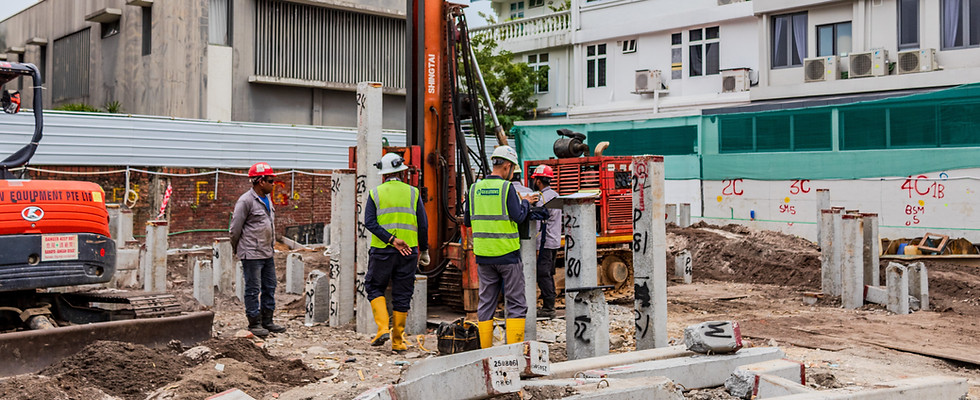
High Strain Dynamic Load Testing (PDA) is a proven method for evaluating the performance of driven piles, bored piles, barrette piles, and other deep foundation elements. Using the Pile Driving Analyzer® (PDA-8G), accelerometers and strain transducers are attached to the pile to measure its response under impact from a hammer or drop weight. The test provides real-time insights into static soil resistance and distribution, pile structural integrity, dynamic stresses, and hammer energy transfer.
PDA testing is highly efficient, allowing rapid assessment of foundation capacity without the need for extensive static load setups. Results can be complemented by CAPWAP® signal matching analysis, which correlates closely with static load test outcomes. The PDA system supports both wired and wireless configurations, with smart sensor technology ensuring accurate calibration and error-free data collection.
This method is widely recognized as a reliable, economical solution for foundation verification, enabling engineers to establish driving criteria, optimize pile installation, and confirm long-term performance with confidence.
Table 1 - Joint BCA/IES/ACES/GEOSS circular 2016 - Requirements on ground investigation, load test and quality control test for foundations of building of 10storeys or more
The Building and Construction Authority (BCA) mandates that for buildings with ten storeys or more, Non-Destructive Integrity Test (High-strain dynamic test or sonic logging test) must be conducted as part of the pile testing schedule, and these tests can be effectively carried out using the PDA. According to the requirements, NDITs must be performed on at least two working piles or 2% of the total number of working piles, whichever is greater.
INSTRUMENTATION
Accurate instrumentation is at the heart of every successful High Strain Dynamic Test. Geolutions deploys Pile Dynamics’ strain sensors and accelerometers, engineered for reliability, convenience, and durability in demanding site conditions. These sensors capture high-resolution acceleration and micro-strain signals, enabling precise evaluation of pile stresses, soil resistance distribution, and structural integrity.
Each sensor is traceable to NIST calibration standards, with calibration sheets provided and regular re-certification in line with ASTM D4945 requirements. Smart Sensor Technology ensures automatic identification of sensor type, serial number, and calibration factor, eliminating manual input errors and guaranteeing consistent data quality.
Our instrumentation is versatile — equally effective for driven piles, bored piles, and barrette foundations — and available in both wired and wireless configurations to suit site constraints. Installation is straightforward across steel, timber, and concrete piles, with symmetrical placement around the neutral axis to account for bending effects.
By combining robust instrumentation with our accredited testing expertise, Geolutions ensures that every PDA test delivers dependable, traceable, and technically valid results that clients can trust.
EXPERIENCE
Geolutions has built extensive expertise in High Strain Dynamic Load Testing (PDA), delivering results across Singapore’s most complex infrastructure projects. We have successfully executed Non-Destructive Integrity Tests (NDITs) using the PDA method for a wide range of developments — from HDB housing projects and JTC industrial works to major LTA infrastructure such as the North-South Corridor (NSC), Jurong Region Line (JRL), and Cross Island Line (CRL), as well as high-profile projects including Marina Bay Sands IR2, Changi Terminal 5 Airport, and numerous residential and commercial buildings.
Our team manages the entire testing cycle in-house: sensor installation, instrumentation design, drop height calculation, test execution, monitoring, CAPWAP® analysis, QP endorsement, post-test discussions, and integrity verification. By avoiding subcontracting, we maintain full control over quality, accountability, and consistency.
We have deployed advanced test methods combination and introduced fibre optic instrumentation for enhanced monitoring, while integrating PDA testing with complementary methods such as PIT, Sonic Logging, and Coring. With a robust workforce and proven track record, Geolutions consistently delivers accurate, efficient, and dependable PDA results that clients can trust for safe foundation design and long-term structural performance.
